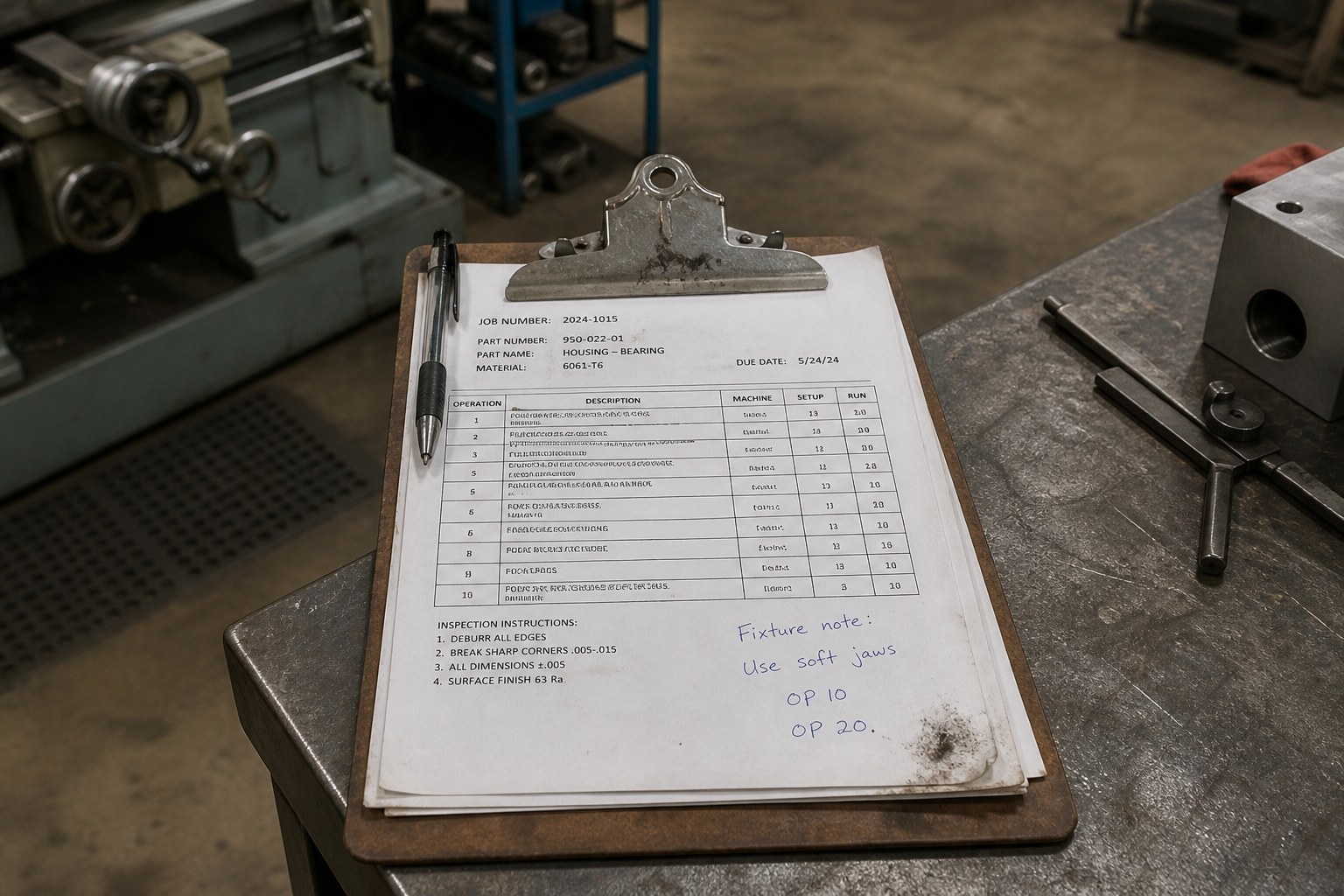
First shift. A 50-person shop. The traveler came off the printer Friday afternoon. It has a job number, a part number, a routing that looks complete, and a due date someone in the office believed.
The setup guy has a clipboard.
The clipboard has the real fixture. The real speeds. A note from the last time this part ran, in a handwriting the office does not have a login for. The short-run warning that is not in the traveler because the traveler is a copy of a routing that was true in March. The material is late. The packet still says op 3. The floor is on op 1, waiting on stock that receiving already knows about and the packet does not.
The owner bought ChatGPT in the spring. The estimator used it this morning to make a quote email sound less stiff. That is the AI. Then he pasted the email into the same thread the shop has used since the last ERP go-live, attached the same traveler template, and sent a due date the floor cannot see.
If you cancelled the seats tomorrow, first shift would look the same.
The job still lives on a clipboard.
The packet is a picture of a job that already moved
Owners in this trade know the feeling even when they call it something else. The office had a clean week. Jobs got entered. Packets got printed. The board has job numbers. The machines are running.
Ask where job 4419 actually is.
The honest answer is not in the system. It is in a head, or on a hook on a machine, or in a text to the guy who ran it last time. The packet is what the office needed in order to feel like the job had a home. The clipboard is what the floor needed in order to not scrap the part.
That gap is not a discipline problem. It is what you get when the system of record cannot hold a change.
A job in a shop is not a row. It is a path. Material shows up or it does not. The first-article is good or it is not. The customer calls at 10am and moves the date, or the quantity, or the finish. Someone on the floor finds a better way to hold the part and does not write it down because writing it down means a form, and the form means a week, and the part is due Thursday.
The clipboard listens. The packet does not.
So the floor does the only rational thing. They run the real job, and they let the paper trail stay pretty.
If you have never stood next to that, you will hear "we need better adoption" and buy training. The floor does not have an adoption problem. The floor has a system that goes stale the first time the work disagrees with the printout.
A seat does not hold a job
ChatGPT is a tool a person opens. A job is what the business does when a traveler, a PO, or a rush hits the counter.
Mixing them up is how you spend a year feeling modern and still miss the same Friday.
A job has a start. A print, a file, a call. It has a path, even if the path is messy. It has a next operation that should not require a hero. It has a state you can ask about without walking out to the machine.
A seat has a cursor. You type. It answers. You leave.
Watch it happen. An estimator drops a customer print into the chat. The model returns a clean summary of the notes. He copies three bullets into the quote. He does not copy the callout in the title block that changes the material, because the summary sounded complete. The job gets sold on the wrong stock. The chatbot was helpful. The workflow was still a copy-paste.
Or a supervisor asks the model to write a better work instruction. Good paragraph. Then the paragraph lives in email, the speeds live on the clipboard, the fixture note lives in a head, and the version the new hire reads is not the version that made a good part last month. You did not get an operating system. You got faster words around the same break.
This is why "we use AI" can be true and still be nothing.
Ask it in the shop, not the office. If you cancelled the AI logins tomorrow, would the job move differently? Would receiving still update a person instead of the job? Would setup still live on a clipboard one person understands? Would the 10am change still die in a voicemail?
If the honest answer is no, you bought a writing assistant for the front office. You did not build infrastructure for the work.
The floor is not hiding the process. The process will not sit still.
Packaged software fails here for a boring reason. It wants the routing to be true at the moment you typed it, and then it wants you to live inside that truth.
A 50-person shop does not work that way. The routing is a guess that gets smarter as the part runs. The good shops already know this. They have a setup person who is worth more than the module you were quoted, because that person is the system. They remember which fixture actually holds. They know which customer will reject a finish that is technically in spec. They know the machine that "can" do the op and the machine that should.
When you buy a packaged MES, or another module on the ERP you already resent, you are asked to pour that person's head into screens someone in another state designed for a different shop. The first week is data entry. The second week is workarounds. The third week the clipboard is back, because the clipboard still listens when the process changes on a Wednesday.
That is not the floor being difficult. That is the floor protecting the part.
The companies that get something real out of software in a shop put the job in a system that can change when the floor is right. Not a chat window on the side. Not a traveler PDF that gets printed again and taped over the last one.
The job. The routing as it is, not as it was entered. The setup note. The next operation. The change that happened at 10am. The question the owner asks on Friday that used to mean walking the floor.
One process is enough to start. First-article. Expedite. "Where is this job?" Whatever makes the week slip.
Build that. Put it in the team's hands. Change it when the floor says it is wrong.
That last sentence is the part most custom software skips. The system freezes the day it ships. People go back to the clipboard because the clipboard still listens.
Days, not a scope document
This is the claim only Mantum can make, and it is not a shop-floor claim. It is a factory claim.
We do not sell a manufacturing product. We build the broken workflow as software that matches how you already run, and we keep building it after the first version is in someone's hands. The floor flags the bottleneck. They name the data point that was missing. The system gets configured around the process they already have. The update goes live in days, not after a rigid no about scope.
We have that in the wild, not in a machine shop. ALO Property Group is a commercial real estate firm in Indianapolis. Their brokers used to keep the client in private CRMs the firm could not see. The next step lived in a login only one producer had. They built ALO CRM around the floor they already had. When the process needed a new field, it did not die in a requirements document. It shipped in days. Hundreds of product updates in 45 days.
A shop is not a brokerage. The pattern is the same. The real job lives outside the system. The system that wins is the one that can move when the floor is right.
If your current vendor needs a statement of work to add the note that is already on the clipboard, you do not have a partner. You have a product with your logo on a generic routing.
What this is not
If the seats help someone write a clearer quote email, keep them. Just stop calling that adoption. Do not ban the clipboard on Friday either. If you ban the paper before the new path works, people will build a worse clipboard in a notebook they take home.
Mantum builds a custom system for a broken workflow. The job. The next operation. The Friday question. Not a packaged MES with your logo on a generic traveler, and not a claim that a model will run the shop.
We are not going to tell you the clipboard is romantic. It is a failure of the system, held together by people who care about the part. That is also why it works. Any replacement that cannot be corrected by the person standing at the machine will lose to it.
Walk one job before you buy another login
Do it as a thought, not a procurement event.
Pick one live job. Not a hypothetical. A real one on the board this week.
Write the path on a single page. Where the print came in. Who entered it. What they copied. What they left out. Who printed the traveler. What the setup guy actually used. Where the 10am change went (a head, a text, a sticky, nowhere). What the owner would have to do, right now, to answer "where is this?"
Circle the first place the job left the system. That circle is more honest than an AI strategy.
If the circle is the clipboard, you do not have a training problem. You have a system that cannot hold the work.
If you want that path built as software that matches how you already run, tell Mantum what is broken. Not the module you wish you had. The handoff that keeps slipping. The note that only lives in one person's handwriting.